
There are four classical elements in nature: Earth, Wind, Fire, and Water. The fifth element is Energy. |
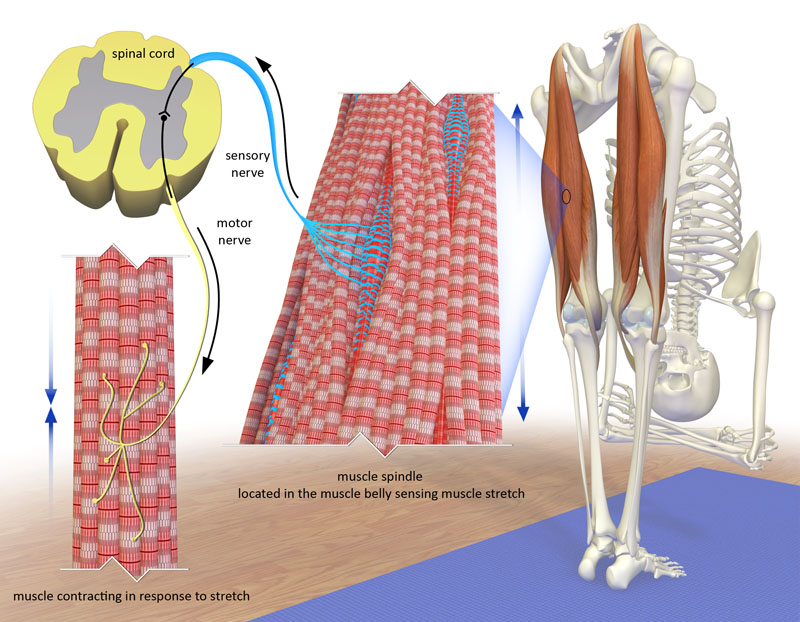
| The muscle spindle is a sensory receptor that is located in the "belly" of all skeletal muscles. It detects changes in length and tension within the muscle. Basically, when a muscle stretches, the muscle spindle sends a signal to the spinal cord, which then signals the muscle to contract and resist the stretch. This protects the muscle from tearing and is known as a "spinal cord reflex arc." The muscle spindle is one of the reasons we never force ourselves into a stretch in yoga. Forcing a stretch intensifies the firing of the muscle spindle, causing the muscle to contract. This mechanism may block deepening of the stretch. Never force yourself into a stretch, but rather "dissolve" the blockages slowly by working with the spinal cord reflex arcs. |
||
|
Figure 2 illustrates the spinal cord reflex of the muscle spindle. Note the synaptic vesicles carrying neurotransmitters from the sensory nerve of the muscle spindle to the motor nerve that signals the muscle to contract. All of this takes place at the level of the spinal cord without our conscious awareness. This is a "primitive" reflex that occurs in response to a biomechanical event, the lengthening of a muscle. The following images use Uttanasana to describe a technique for "reassuring" the muscle spindle that we are carefully stretching during our practice. |
Fig 2: 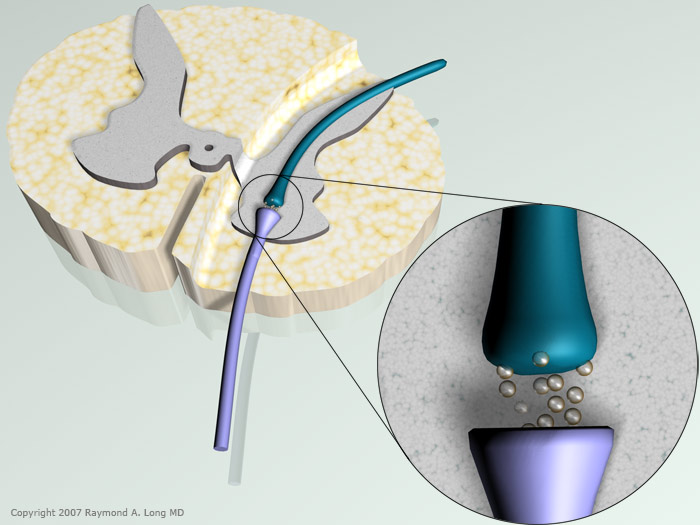 |
|
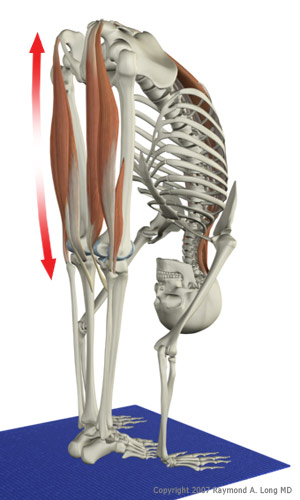 |
Let's begin by looking at Uttanasana. Carefully bend forward until you feel a moderate stretch. The muscle spindles of the hamstrings and erector spinae will fire in response to this stretch and send a signal to the spinal cord. This is the first part of the reflex arc. The second part is the outgoing signal from the spinal cord to the muscle. This involves the motor nerve and stimulates the muscle to engage. This contraction of the hamstrings and erector spinae is part of what may prevent deepening of the posture. Fig 3: Hamstrings stretching in Uttanasana. |
|
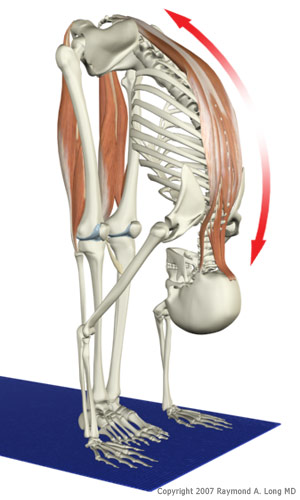
| Here the same reflex arc goes into action for the erector spinae muscles. The muscle spindle signals that the erector spinae are stretching and the spinal cord signals them to contract. Fig 4: Erector spinae stretching in Uttanasana. |
 |
|
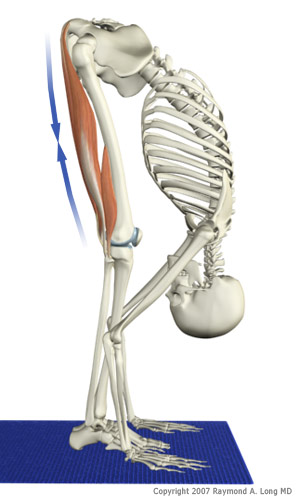 |
"Dissolve" reflex contraction of stretched muscles by slightly relaxing the stretch. This decreases the firing of the muscle spindle stretch receptors. You can do this for the hamstrings by slightly bending the knees. Hold this milder stretch for a few breaths. Fig 5: Relaxing the hamstrings in Uttanasana. |
|
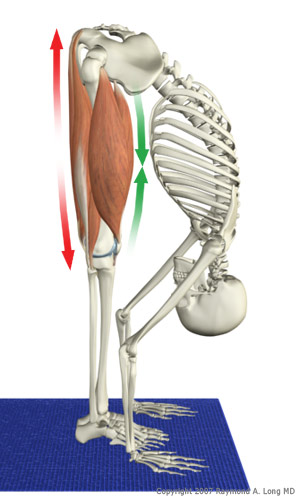
| Once the muscle spindle acclimates to the milder stretch, activate the quadriceps to straighten the knees and deepen the pose. Engaging the quadriceps inhibits the reflex contraction of the hamstrings caused by the muscle spindle. It may seem counter-intuitive, but we can actually deepen a stretch by first backing off on the stretch. Fig 6: Activating the quadriceps to stretch the hamstrings in Uttanasana. |
 |
|
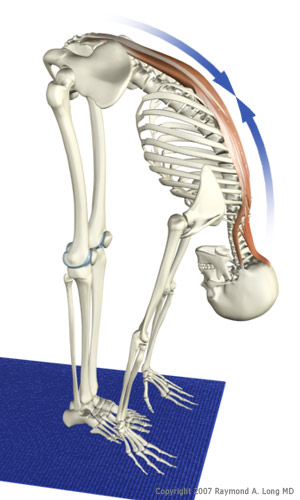 |
As with the hamstrings, you can dissolve the reflex contraction of the erector spinae by slightly relaxing the stretch. This decreases the firing of the muscle spindle stretch receptors. Do this for the erector spinae by lifting the back slightly from the hips. Hold this milder stretch for a few breaths. Fig 7: Relaxing the erector spinae in Uttanasana. |
|
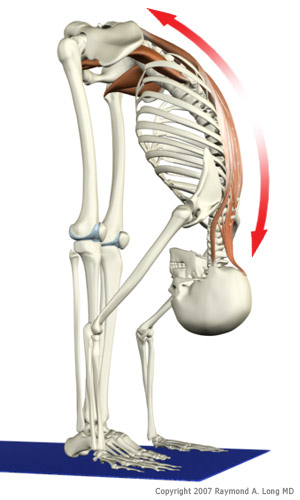
| Once the muscle spindle of the erector spinae acclimates to the milder stretch, contract the psoas and rectus abdominis to flex the hips and torso and deepen your pose. Engaging the psoas inhibits the reflex contraction of the erector spinae. Fig 8: Activating the psoas to stretch the erector spinae in Uttanasana. |
 |
|
| Practice tips: You can use this technique to deepen any posture that stretches your muscles. It is an excellent technique if you are new to yoga or teaching practitioners who are new to yoga. It also works well if you have not stretched in a while. In summary, work with the muscle spindle as follows: 1) Back off approximately 20% from a full stretch. Make sure you feel a mild stretch so that some of the muscle spindles are still firing. 2) Hold the milder stretch for 3 to 4 breaths to acclimate the muscle spindle and reassure it that you are stretching safely. 3) Then, with control, carefully go deeper into the pose by engaging the opposing muscle group. If you are new to integrating anatomy into your practice, remember that it is not necessary to memorize this technique on your first pass. Begin by enjoying the beautiful images of the body in yoga. This alone will awaken your brain's awareness of the anatomy during your practice. Return at a later date for a closer look and then gently go through the motions illustrated above as you do this pose. Then leave it. Your unconscious mind will create new circuitry while you rest. Enjoy the process and when you return to the mat, you will be surprised at how easily you access this technique. Namasté, Ray and Chris |
||






